
Updated October 21, 2026 · By Jane Carlego
Best Butane Torch for Acrylic Pouring
A small butane torch pops surface bubbles and can help cells rise in a fresh pour. Below are three torches worth using, a flame-free heat gun, and the one rule paint makers stress above all: never torch a pour that contains alcohol.
Read this first
Never Torch a Pour That Contains Alcohol
Some pour recipes, including Golden’s own starter recipe, use 70% isopropyl alcohol to create cells, and alcohol is highly flammable. Asked about torching pours, Golden Artist Colors’ technical team called heat or flame with isopropyl alcohol “a very dangerous combination” and asked artists not to do it. Torch only plain or silicone pours, and keep the flame moving.

Best for most pour artists
Sondiko S907
For about $20, the S907 has what bubble popping needs: a narrow flame you can aim, a flame lock so you are not squeezing a trigger between passes, and a fuel window so it does not die halfway across a canvas.
The picks
Three Torches and a Heat Gun for Pour Art
All four were in stock on Amazon.com when checked on October 21, 2026. We earn a commission on qualifying Amazon purchases, at no extra cost to you.
Best for most pour artists
Sondiko S907
A $20 refillable kitchen torch with a fuel window and a flame lock. Its narrow flame suits popping surface bubbles on small and medium pours.
Keep in mind: Owners report ignition failures, and some units wear out within a few months of regular use.
Best for large pours
Iwatani PRO2
A torch head that locks onto a butane canister, with separate controls for flame strength and flame shape. The wide setting covers more canvas per pass.
Keep in mind: It runs on Iwatani-compatible cassette canisters, not a refillable tank, so it is taller than a kitchen torch.

Best for long studio sessions
Blazer GT8000 Big Shot
A heavier refillable torch with a removable tabletop base and an anti-flare brass nozzle, for artists who torch often.
Keep in mind: At $57.84 when checked, it costs nearly three times the Sondiko and has no fuel window.

Best flame-free option
BLACK+DECKER HG1300 heat gun
A corded 1,350 W heat gun with two settings, for warming a pour without an open flame.
Keep in mind: It blows hot air, and pour artists often report that the airflow pushes wet paint around.
Earlier versions of this page recommended the Dremel VersaFlame 2200-01, which Amazon listed as currently unavailable on October 21, 2026. Dremel now sells the same torch as the 2200-5, with five accessories. At about $49 from a third-party seller, it costs more than the Sondiko or Iwatani, and its soldering and hot-air attachments add little for pour art, so it is not a pick here. Our Dremel VersaFlame review covers the 2200-5 if you also need those functions.
At a glance
Side-by-Side Comparison
Temperatures are manufacturer listings. Runtimes come from the listings or our own reviews, and drop as the flame gets bigger.
| Tool | Best for | Heat source | Runtime | Listed max temperature | Price, Oct 21, 2026 |
|---|---|---|---|---|---|
| Sondiko S907 | Small and medium pours | Butane flame, refillable | 20 to 50 min | 2,372°F | $19.99 |
| Iwatani PRO2 | Large canvases | Butane flame, canister | About 100 min at max | 2,700°F | $39.99 |
| Blazer GT8000 Big Shot | Frequent studio use | Butane flame, refillable | About 35 min, moderate flame | 2,500°F | $57.84 |
| BLACK+DECKER HG1300 | Flame-free warming | Hot air, corded | Unlimited while plugged in | 750°F or 1,000°F air | $39.99 |
The picks in detail
What Each Tool Does Well, and Its Limits
Owner-feedback notes summarize recurring patterns in Amazon reviews for each exact listing, not every unit.
Best for most pour artists
Sondiko S907
The S907 is the torch to start with. It costs about $20, the flame is narrow enough to pop bubbles without heating the whole canvas, and the flame lock keeps it burning between passes. Sondiko lists a 10 g tank that runs 20 to 50 minutes per fill, a transparent gauge with a MAX line, and a flame temperature of up to 2,372°F. Its own listing names resin art among its uses.
The TBTEEK kitchen torch that earlier versions of this page recommended shares the GF-907 model designation with this Sondiko, which Sondiko lists as GF-907A. On October 21, 2026, the TBTEEK listing was down to its last unit, so the Sondiko is the safer way to buy that design.
Price (Oct 21, 2026)
$19.99
Fuel
Refillable butane, 10 g tank
Listed runtime
20 to 50 minutes
Listed flame temperature
Up to 2,372°F
Controls
Thumb ignition, flame dial, lock
Warranty
1 year, manufacturer
Pros
- Cheapest torch here, at about $20
- Narrow flame for targeted bubble popping
- Fuel window shows when to refill
- Flame lock between passes
Cons
- Owners report ignition failures
- Some units wear out within a few months
- Small tank for long sessions
- Mixed reports on how easy it is to fill
Best for: Hobby pour artists doing small and medium canvases. Our Sondiko S907 review covers filling and the controls in detail.
Best for large pours
Iwatani PRO2
The PRO2 is a torch head that twists onto an Iwatani cassette-fuel canister. Its separate controls for flame strength and flame shape let it switch from a tight point to a wider flame, which is the useful part for pour art: a wider flame covers a large canvas in fewer passes. Iwatani lists a flame temperature of up to 2,700°F, and our review puts runtime at about 100 minutes at maximum power from a full canister.
The stabilizing stand keeps it upright between passes. The trade-off is size: with a canister attached it stands taller than a kitchen torch, and you need compatible cassette canisters on hand.
Price (Oct 21, 2026)
$39.99
Fuel
Iwatani cassette canister, sold separately
Listed runtime
About 100 minutes at maximum
Listed flame temperature
Up to 2,700°F
Flame controls
Strength and shape
Stand
Stabilizing plate
Pros
- Wide flame setting covers large pours faster
- Separate shape and strength controls
- Long runtime per canister
- Quick canister changes
Cons
- Taller and heavier with the canister attached
- Needs compatible cassette canisters
- Owners are split on flame strength
- Stock was limited when checked
Best for: Artists who pour on big canvases or do several pieces in a session.
Best for long studio sessions
Blazer GT8000 Big Shot
The GT8000 is a bench torch rather than a kitchen gadget. Blazer lists a 2,500°F flame, a gas-flow dial for flame length, piezo ignition, an anti-flare brass nozzle, and a removable tabletop base. Our review puts runtime at about 35 minutes at a moderate flame and notes a one-year limited warranty.
For pour art, the base is the main draw: the torch stands steady on the table between passes. Owners on Amazon describe a strong, consistent flame, though some report the metal nozzle getting red-hot and the ignition wearing over time. It also lacks a fuel window.
Price (Oct 21, 2026)
$57.84
Fuel
Refillable butane
Runtime (our review)
About 35 minutes, moderate flame
Listed flame temperature
2,500°F
Base
Removable tabletop base
Warranty
1 year, limited
Pros
- Stable tabletop base
- Anti-flare brass nozzle
- Strong, consistent flame per owners
- Gas-flow dial sets flame length
Cons
- Most expensive pick, at $57.84
- No fuel window
- Some owners report the nozzle getting red-hot
- Ignition wear reported over time
Best for: Artists who torch several times a week and want one sturdy tool for the studio bench. See our Blazer GT8000 review.
Best flame-free option
BLACK+DECKER HG1300 heat gun
Some pour artists skip the flame entirely. The HG1300 is a corded 1,350 W heat gun with 750°F and 1,000°F settings, a built-in stand for cooling down, and a side handle. Because it plugs in, it never runs out of fuel mid-session.
The catch is airflow. A heat gun blows hot air across the surface, and artists commenting on Golden’s pouring article report that a heat gun or hair dryer moves the wet paint more than a torch does. Start on the low setting and keep it moving.
Price (Oct 21, 2026)
$39.99
Power
1,350 W, corded
Settings
750°F and 1,000°F
Stand
Built-in, for cooldown
Fuel
None, plugs in
Amazon rating
4.8 (10,884 ratings)
Pros
- No open flame near paint additives
- Never runs out of fuel
- Two heat settings
- Highly rated by owners
Cons
- Airflow can push wet paint
- Needs an outlet and a cord
- Still hot enough to scorch paint
- Some owners report failure after a few months
Best for: Artists who would rather not keep butane and an open flame in the studio, or who work with additives they are unsure about.
Technique
How to Torch an Acrylic Pour Safely
A torch does two jobs on a fresh pour: it pops bubbles trapped at the surface, and its heat can help cells come up in pours made with silicone. These steps keep both jobs safe.
- Mix ahead and let it rest. Golden’s technical team suggests storing mixed pour paint overnight in a sealed container so mixing bubbles can rise and pop before you pour. Fewer bubbles means less torching.
- Check what is in the paint. If any layer contains isopropyl alcohol, do not use a torch. Pop stray bubbles with a toothpick instead.
- Clear the table. Keep plastic cups, drop sheets, paper towels, and the butane can away from the flame. Work on a heat-resistant surface with good ventilation.
- Light the torch away from the canvas. Set a moderate flame and engage the lock only once the flame is steady.
- Make quick, sweeping passes. Artists’ published accounts put the flame about 2 to 6 inches above the paint, always moving. Never pause over one spot. Practice on a scrap pour first.
- Stop when the bubbles are gone. Extra heat after that only raises the risk of scorching. Set the torch on its base to cool, flame off.
Why cells form, and what heat does
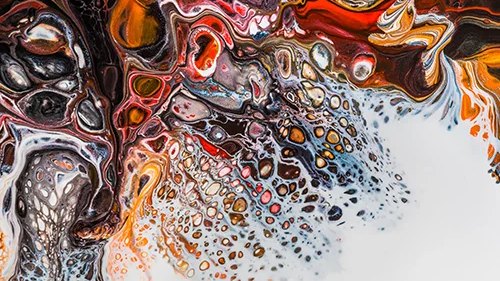
Cells appear when lighter, lower-density paint pushes up through heavier layers above it. Golden’s technical team explains that alcohol is less dense than water and carries the paint mixed with it toward the surface as it escapes, which is why alcohol pours form cells without any heat. Silicone pours are different: artists use a quick pass of heat to help trapped silicone and air reach the surface, which is where most torching happens.
If the painting needs to last
Golden does not endorse silicone oils or torching for archival work. Its team says it does not know what torching releases into the air or whether the heat alters how the acrylic film forms. For a piece you plan to sell or keep for decades, let the paint rest, pop bubbles by hand, and skip the torch.
Buying advice
Match the Tool to How You Pour
The right tool depends on the size of your canvases and what is in your paint.
Bubbles only
Start with a small torch
If you only pour a few times a month, a $20 kitchen torch like the Sondiko S907 is all you need.
Read the S907 review →Large canvases
Go wider, not hotter
A torch with an adjustable flame shape, like the Iwatani PRO2, covers more surface per pass. More heat in one spot is what scorches paint.
Read the PRO2 review →Frequent pouring
Buy for stability
If you torch several pieces a week, a torch with a proper tabletop base, like the Blazer GT8000, is easier to set down safely between passes.
Read the GT8000 review →Fuel
Use clean butane
Refined butane is less likely to clog a small torch jet mid-session. Fill the torch before you start mixing paint, not next to a wet pour.
Read the fuel guide →Questions
Frequently Asked Questions
Do you need a torch for acrylic pouring?
No. A torch is optional. It pops surface bubbles and can help cells surface in silicone pours, but you can reduce bubbles by letting mixed paint rest overnight in a sealed container and popping the rest with a toothpick.
Can I use a kitchen torch for acrylic pouring?
Yes. Refillable culinary torches such as the Sondiko S907 are a common choice for pour art. Keep the flame moving and test on a scrap pour first.
Is it safe to torch a pour that contains isopropyl alcohol?
No. Isopropyl alcohol is highly flammable, and Golden Artist Colors’ technical team specifically warns artists not to combine heat or flame with alcohol pours. Use a toothpick or let bubbles rise on their own.
Should I use a torch or a heat gun for acrylic pouring?
A torch gives targeted heat with little airflow, so it suits popping bubbles in specific spots. A heat gun warms a wider area without an open flame, but its airflow can push wet paint around. Many artists start with a small torch.
How far should I hold the torch from the paint?
Artists’ published accounts range from about 2 to 6 inches, with quick sweeping passes. Start at the far end of that range on a scrap pour, and never hold the flame over one spot.
Does torching affect how long the painting lasts?
Nobody can say for sure. Golden’s technical team does not endorse torching or silicone for work meant to last, because it is unknown whether the heat affects how the acrylic film forms. For archival pieces, rest the paint and skip the torch.
Editorial note
How We Built This Guide
This guide is research-based and does not claim hands-on testing. Product details come from manufacturer listings, our existing reviews, and Amazon’s summaries of owner reviews, all checked on October 21, 2026. Technique and safety guidance comes from Golden Artist Colors and its technical team’s answers on the University of Delaware’s MITRA forum. Prices and stock change often.