
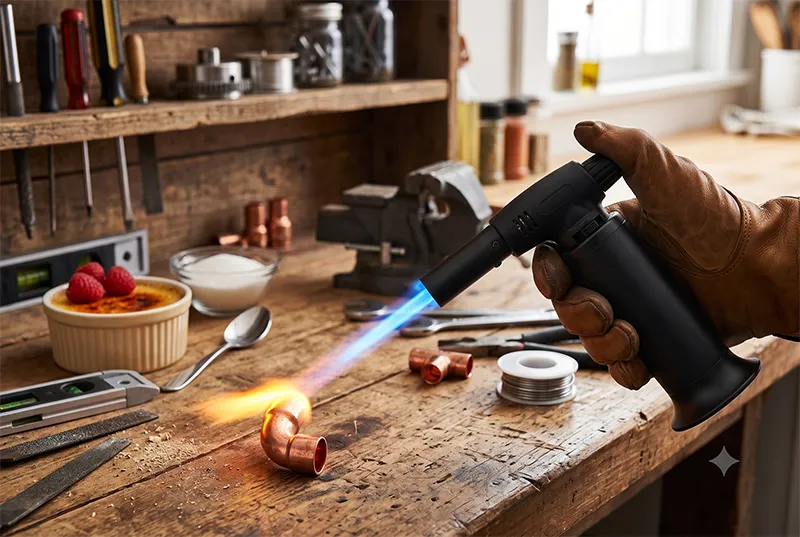
The right butane torch should feel comfortable in your hand, light reliably, and give you enough control for the job. A model that works well for crème brûlée may not be powerful or durable enough for jewelry making, soldering, or frequent workshop use.
Before comparing brands, decide what you plan to do with the torch. Then look at flame control, ignition, fuel capacity, safety features, build quality, and ease of refilling.
Here is how to choose a butane torch that fits your needs without paying for features you will never use.
Readers who are ready to compare specific models can also see our guide to the top butane torches.
Start With the Job You Need the Torch to Do
Your intended use should guide every other decision.
Cooking
A kitchen torch should offer a focused, adjustable flame that is easy to control. It should also be light enough to move steadily across food without tiring your hand.
Common culinary uses include:
- Caramelizing crème brûlée
- Browning meringue
- Toasting marshmallows
- Charring peppers
- Melting cheese
- Finishing the surface of meat
For most home cooks, precise flame control matters more than maximum power.
Jewelry Making and Crafts
Jewelry work often requires a stable, concentrated flame. Look for a torch that can remain lit without forcing you to hold down the ignition button.
A comfortable grip is especially important when you need to direct the flame at a small area for more than a few seconds. A sturdy base can also help prevent the torch from tipping over between uses.
Soldering and Small Repairs
For light soldering, heat-shrink tubing, wire work, and similar repairs, choose a torch with a narrow flame and dependable ignition.
Some models include interchangeable tips for soldering, hot-air work, or heat application. These accessories can be useful, but only when they match the type of work you actually perform.
Lighting Grills, Fireplaces, and Candles
For simple lighting tasks, reach and ease of use may matter more than fine flame control. A longer nozzle helps keep your hand farther from the ignition point.
Look for a child-resistant ignition mechanism where applicable. Child resistance does not mean childproof, so keep the torch and its fuel out of children’s reach.
Choose the Right Torch Style
Butane torches generally fall into two practical categories.
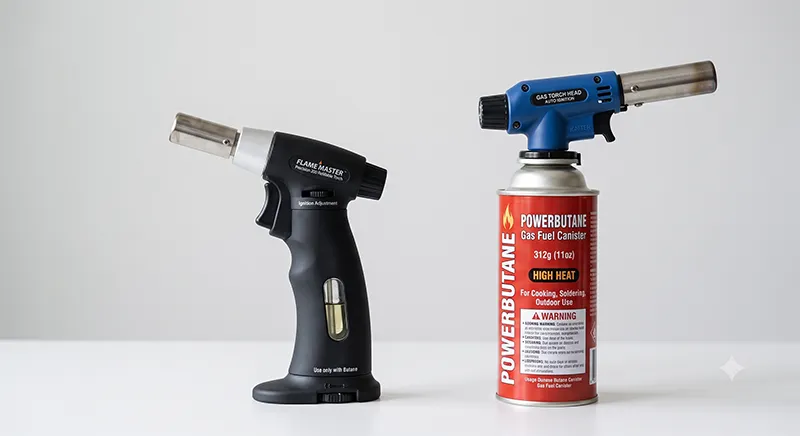
Refillable Tank Torches
These torches have a built-in fuel reservoir. You refill them using a separate can of butane.
Refillable models are usually compact and easy to store. They work well for kitchens, craft rooms, and occasional repairs. Fuel capacity varies, so check how long the model is expected to run between refills.
Canister-Mounted Torches
Canister-mounted torches connect directly to a compatible butane canister. They generally hold more fuel than compact refillable models, which can make them convenient for longer sessions. Heat output and flame performance vary by model, so compare the manufacturer’s specifications rather than assuming a canister-mounted torch is more powerful.
Look for Adjustable Flame Control
An adjustable flame gives you more control over heat intensity and flame size.
A low setting is useful for delicate work, such as browning meringue or heating a small jewelry component. A stronger setting is better for larger surfaces or jobs that require faster heating.
The adjustment control should move smoothly and stay in place once set. Avoid models with loose knobs or vague settings that make it difficult to repeat the same flame.
Look for a flame shape suited to the task. A narrow, pointed flame can help with detailed work, while a wider flame spreads heat across a larger surface.
Consider the Ignition System
Many butane torches use push-button piezoelectric ignition, which creates a spark without a match or separate lighter. Other models use different ignition systems, so check the product description before buying.
Good ignition should be:
- Easy to operate with one hand
- Reliable after repeated use
- Positioned away from the flame
- Comfortable to press
- Protected against accidental activation
Some torches require you to hold the trigger continuously. Others include a flame-lock function that keeps the torch running after ignition.
A flame lock is convenient for longer tasks, but the control should be easy to release immediately.
Check the Safety Features
A butane torch produces an open flame and should be treated as a serious heat tool. Safety features do not replace careful handling, but they can reduce the chance of accidental ignition or tipping.
Useful features include:
- A child-resistant safety lock
- A stable, wide base
- An easy-to-reach shutoff control
- A flame guard
- A protected ignition trigger
- A clearly marked flame adjustment control
Choose a product whose manufacturer provides clear operating instructions, fuel-compatibility information, safety warnings, warranty details, and reliable contact information. Check the CPSC recall database before purchasing an unfamiliar model.
Read the manual before lighting a new torch. Do not assume that controls work the same way across brands.
Pay Attention to Grip and Balance
A torch can have excellent specifications and still be unpleasant to use.
The grip should fit your hand without forcing your wrist into an awkward position. Controls should be reachable without changing your grip or moving your hand close to the nozzle.
For detailed work, look for:
- A textured or nonslip grip
- Balanced weight
- A trigger that does not require excessive pressure
- Enough clearance between your fingers and the flame area
- A shape that can be set down securely
When shopping online, product dimensions and weight can help, but hands-on reviews often reveal more about comfort than specifications alone.
Compare Fuel Capacity and Run Time
A larger tank usually means fewer refills, but it also adds weight and bulk.
Occasional kitchen users may prefer a smaller, lighter torch. Someone who works on jewelry or crafts for extended periods may value a larger reservoir or canister-mounted design.
Manufacturers do not always measure run time under the same conditions. Treat advertised figures as estimates, especially when flame intensity can be adjusted.
A fuel-level window or gauge is helpful because it lets you see when the torch is running low.
Inspect the Build Quality
A well-made torch should feel solid, with controls that operate cleanly and a nozzle that does not wobble.
Look for heat-resistant materials around the burner and flame guard. Plastic may be appropriate for the handle or body, but the high-heat components should be designed for repeated exposure to flame.
Warning signs include:
- Loose adjustment knobs
- An unstable base
- A poorly fitted fuel valve
- Controls that stick
- Weak or inconsistent ignition
- Reports of fuel leakage
User reviews can be especially useful for identifying durability problems that appear after several months of use.
Make Sure Refilling Is Straightforward
Refilling procedures vary. Many refillable torches require the torch and refill can to be positioned vertically during filling, but you should follow the instructions supplied with the specific torch and fuel container.
Before buying, check whether the torch requires a particular nozzle adapter or type of butane can.
After refilling, check for escaped fuel or signs of leakage and follow the manufacturer’s instructions before ignition. Never refill a hot torch or refill it near flame, sparks, or another ignition source.
Never refill a hot torch or refill near an open flame.
Do Not Choose on Maximum Temperature Alone
Maximum flame temperature is only one specification. It does not describe ignition reliability, flame shape, adjustment range, balance, fuel consumption, or ease of use.
Control, consistency, flame shape, comfort, and reliability often matter more.
A very powerful torch can be frustrating when the lowest setting is still too aggressive for detailed work. Match the flame range to the task instead of automatically choosing the hottest model.
Set a Realistic Budget
Basic butane torches are inexpensive, but price alone does not reveal value.
A low-cost model may be enough for occasional desserts or candle lighting. Frequent users should consider spending more for stronger ignition, better controls, improved balance, and replaceable or durable components.
Do not pay extra for a large accessory kit unless you expect to use the included tips and attachments. A simple, dependable torch is often a better purchase than a complicated kit with mediocre parts.
A Quick Butane Torch Buying Checklist
Before placing an order, ask:
- Is this torch designed for my primary task?
- Can I adjust the flame precisely?
- Does it ignite reliably with one hand?
- Does it include a safety lock?
- Is the torch comfortable and well balanced?
- Is the fuel easy to find and compatible?
- How often will I need to refill it?
- Can the torch stand securely when not in use?
- Does the manufacturer provide clear instructions?
- Do long-term reviews mention leaks or ignition failures?
A torch that checks these boxes is more likely to remain useful after the novelty wears off.
Our Final Advice
Choose a butane torch for the work you perform most often.
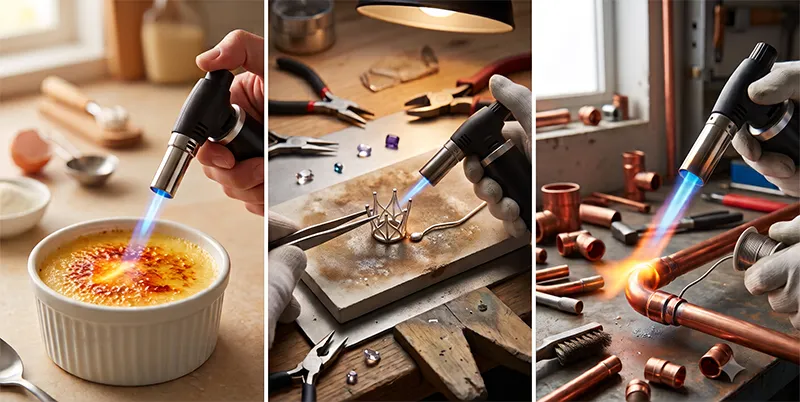
Home cooks should prioritize control, comfort, and simple refilling. Jewelry makers and crafters should look for a stable flame, hands-free operation, and a comfortable grip. Repair work may call for more power, longer run time, or interchangeable tips.
Do not let an impressive temperature claim distract you from everyday usability. The best butane torch is the one that lights reliably, adjusts smoothly, feels secure in your hand, and gives you the right flame for the job.
Before making your decision, compare detailed torch reviews to see how different models perform in real-world use.
Frequently Asked Questions
What is the best type of butane torch for beginners?
A beginner-friendly torch should have push-button ignition, adjustable flame control, a safety lock, and a stable base. Simple controls are usually more valuable than a large collection of attachments.
Is a refillable butane torch better than a canister-mounted torch?
Neither style is always better. Refillable torches are compact and convenient for occasional use. Canister-mounted torches generally offer longer run times but are larger and less convenient to store.
Can one butane torch be used for cooking and crafts?
Some torches can handle both, provided they offer suitable flame control. It is still wise to keep kitchen tools separate from torches exposed to solder, flux, chemicals, or workshop residue.
How important is a flame-lock feature?
A flame lock is helpful for jobs that require continuous heat. For brief kitchen tasks, it may be less important. Any locking control should be easy to disengage quickly.
What safety equipment should I use with a butane torch?
Follow the torch manufacturer’s instructions. Depending on the task, appropriate protection may include safety glasses, heat-resistant gloves, and a nonflammable work surface. Work in a suitable, well-ventilated area and keep combustible materials away from the flame.
How should a butane torch be stored?
Turn the torch off completely and let it cool. Store the torch and fuel according to their manufacturer’s instructions, away from children, heat, direct sunlight, flames, sparks, and other ignition sources. Do not puncture or burn a butane container, even when it appears empty.